

A new personal project: The Tenth Muse (10M)
A living archive of art designed to awaken your creative instinct. Public domain artworks from 17 museums. You can search over 100,000 artworks by feeling, medium, color, etc.

I’m launching a project today that I can’t believe I built. If I had the power to freeze time, study computer science at a top university, I don’t think I could have built what I did in the past six months.
The Tenth Muse (10M) started as a personal challenge after playing with Cursor in 2023 and building a few small personal apps: build a data-intensive, full-stack product. Do the research, brand strategy, design, copywriting, and launch. Of course, I had no idea what I was getting myself into. I wanted to learn.
When I started, the most powerful AI coding models were OpenAI’s o3 and Anthropic’s Sonnet 3. Today, the models are leaps ahead. It’s like going from dial-up internet to virtual reality goggles. I felt in my gut that everything was about to change: my industry, my career, job expectations, and ultimately, my future.
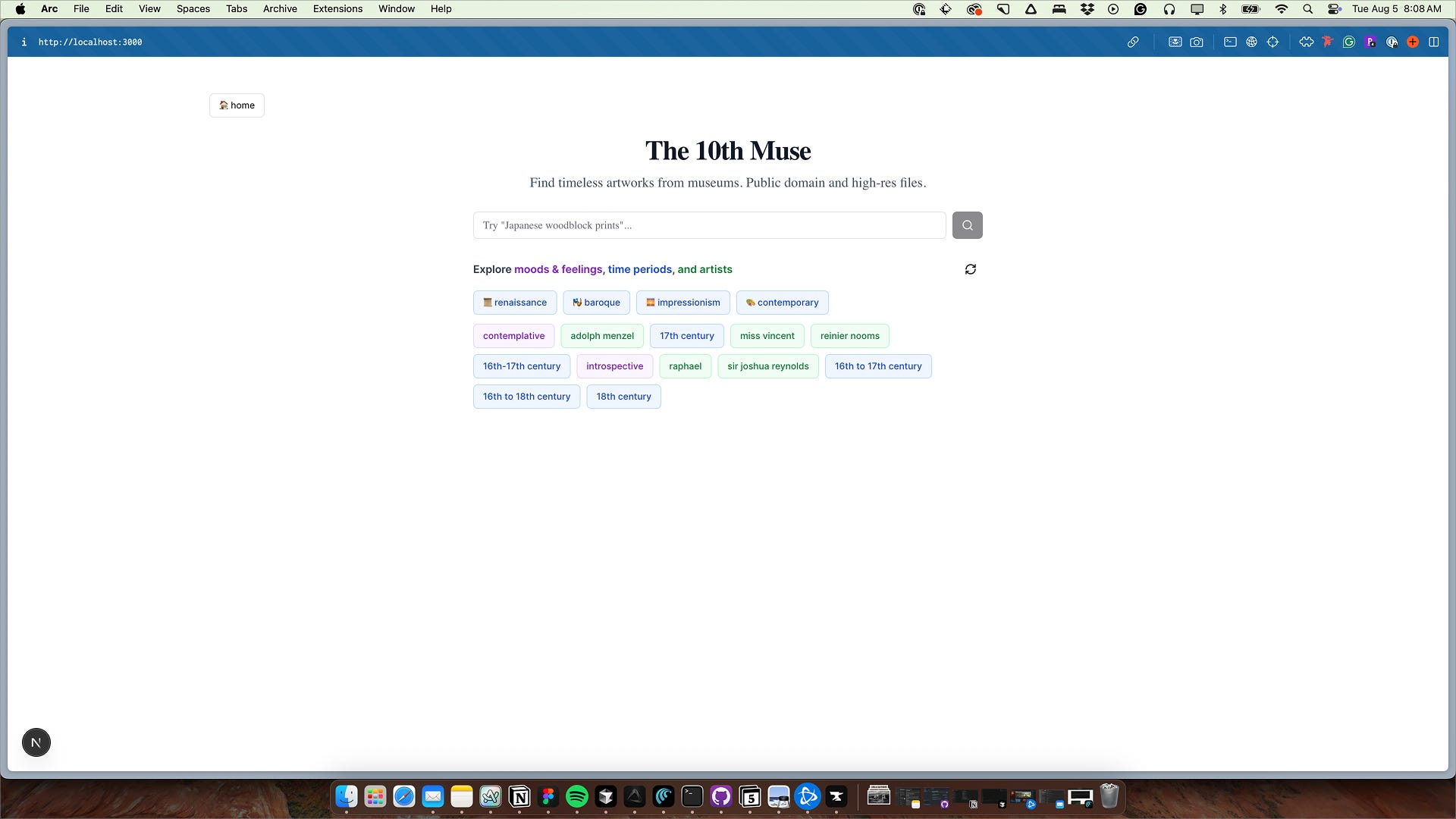
The name comes from Greek mythology. The Nine Muses inspired poets, painters, and philosophers for centuries. In this age of AI, having a point of view and growing mastery are what’s left—and have been timeless to have. Having access to the richest canon of creativity, I hope, helps designers and creatives push back against the sea of sameness.
In this new world, you must be the tenth muse.
I know many “vibe-coded” apps get a lot of hate. But I hope what I’ve built singlehandedly shows what may be possible—and what’s coming.
I started with something I love: museums.
I found that the experience of searching for artworks—for a moodboard, a starting point, a creative spark—was painfully difficult. Most search filters were basic. All of this masterful, timeless work is being buried by clunky interfaces and scattered data. Many institutions, frustratingly, make access to artworks inaccessible. For modern art, I understand why, but for historical archives and images, I believe those should be widely and freely available.
The problem isn’t abundance. It’s architecture and access. The spaces where we discover art shape what we’re capable of discovering. A feed designed for addiction will never facilitate contemplation. A platform that treats a Vermeer the same as a meme will never teach your eye to see the difference.
The internet has billions of images, multiplying by the second. Somewhere in that flood are the works that could change how you see—the painting that stops you mid-scroll, the photograph that names a feeling you couldn’t articulate, the sculpture that makes you reconsider everything you thought about form. But algorithms serve what’s popular, not what’s profound. Platforms optimize for engagement, not for seeing. More art is accessible than at any point in human history, and yet meaningful encounters with it have become rare.
The limitations became obvious: there is no platform that allows people to search by feeling or mood.
I learned that AI has vision capabilities, able to scan thousands of vector points and “read” an image. I tested it on museum artworks and found that most of the keywords used—moody, sad, joyful, regal, complex, sophisticated, opulent—were accurate. This sent me down the rabbit hole. Other than Google Arts and Culture, there is no platform that curates all of this timeless work through mood and emotion filters.
I constantly complain about designers using the same shallow references. I complain that in the age of AI, we are losing connection to the bodies of work that informed, pushed, and changed cultures and genres.
When I worked at an agency, all of our work started in a library that had over 4,000 books—from science fiction to poetry to photography and beyond. It showed up in the work, making it fresh. I always push my designers to go to the library and get off platforms like Pinterest and Behance. Nothing wrong with them, they can be useful, but only living in those places yields recycled inspiration.
10M currently houses over 120,000 artworks form 17 museums and institutions around the world. 95% are in the public domain. A small percentage of famous artworks from The Whitney and MoMA are on display, but only for viewing. You can download any public-domain artworks from other museums at the highest resolution available. I created a feed view, a 3D globe view, and a timeline view that takes you through notable artworks from each era. And I plan to expand further.
I believe in returning to fundamentals, going directly to the source, studying the greats so you can develop your own point of view.
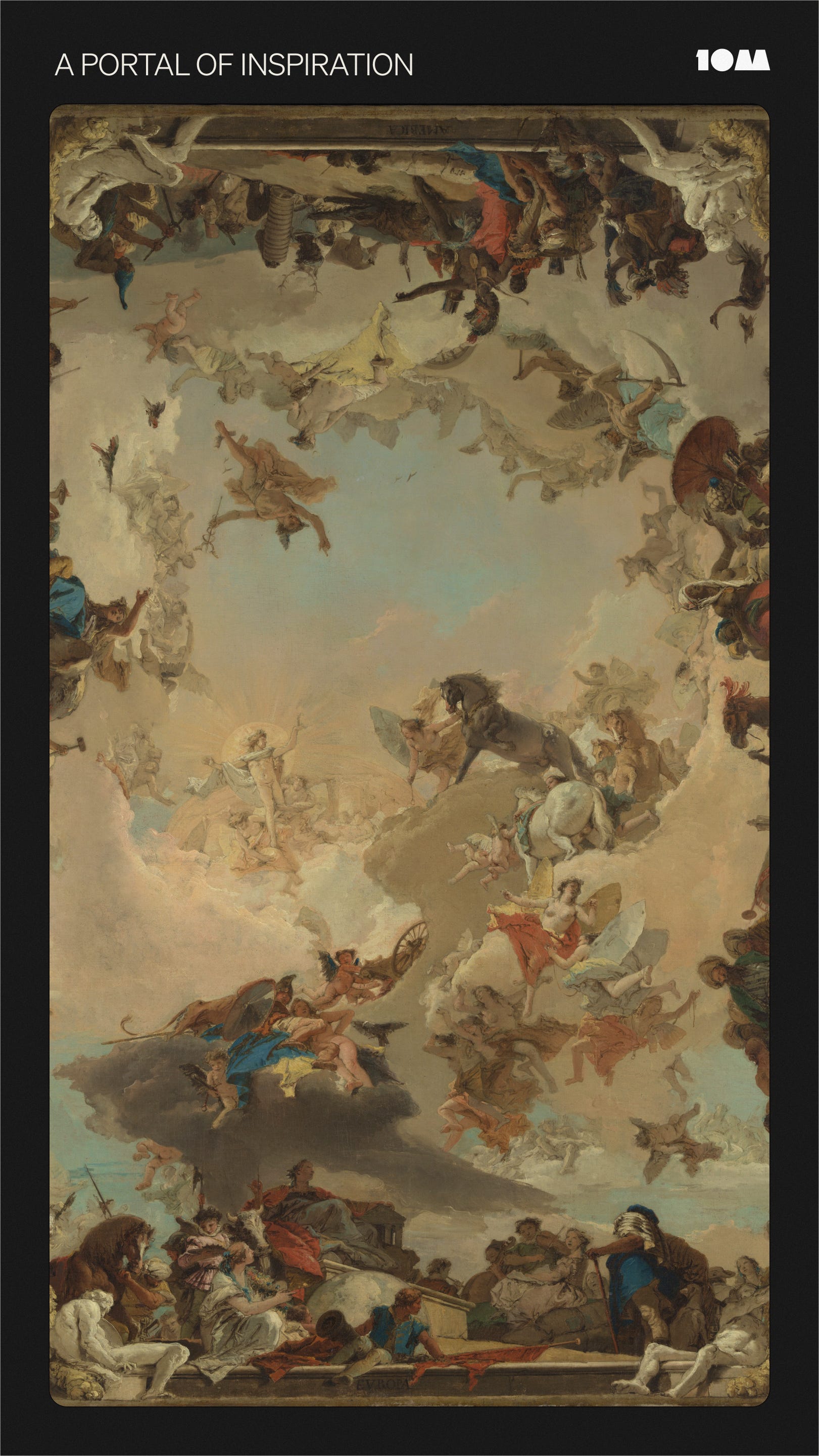
This isn’t a generation tool. You can’t make anything on 10M. You can regenerate your ability to see and feel. If taste is the differentiator in the age of AI, then it grows here by studying the works that shaped genres, movements, and forms. By learning the themes in the works and bringing that into your work. Your next idea might come from an Agnes Martin grid layout. A Japanese woodblock might reshape how you think about form.
There is still metadata to fix, labels to refine, and features to build. But I’m confident it’s in a state worth shipping.
I’m building for the people who stand in front of a painting until the museum guard gets nervous. For the ones who fall down research rabbit holes at 2am. For designers who want to fill their moodboards with artworks that are both timeless and timely. For anyone who’s ever felt that a single image could hold more truth than a thousand words. For the people who may never be able to step foot into a museum, but want to scroll through the greatest canon of creativity.
Taste starts here.
The best experience is on desktop, but I’ll make the mobile version fun soon.
If you’re an institution reading this, please work with me. Let’s make the canon of creativity accessible and open to everyone. There are people who will never set foot in these museums. The least we can do is give them the tools to explore on their own.
Email me at: hello@pauljun.me
Massive thanks to my bud Bobby Jeffries for the logo. Thank you, everyone, who supported me with encouragement and feedback along the way: Mark Johnson, Pedro Marques, Matej Hrescak, Michael Casebolt, David Choe, Jun Cha, Emerline Ji, Nick Ace, Sean Blanda, Julia Reger, Skylar Woodward, Zuzanna Rogatty, Katie Siu, Ryan Davis, Victor Woo, and many more.
Super cool, Paul! Feels like being in a museum.
Just a heads up that I'm getting an error on safari. The page loads, then it goes to a screen that says "Application error: a client-side exception has occurred while loading www.10m.co (see the browser console for more information)."